 Reviews


This Specimen has been sold.

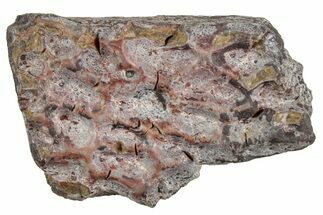

1.6" Triassic Phytosaur (Rutiodon) Vertebra - Texas


This is a 1.6" long vertebra from a Triassic-aged phytosaur (Rutiodon sp.). It was collected from the Dockum Group in Garza County, Texas. There are some repaired cracks through the vertebra, with spots of gap fill restoration through the middle and edges of the specimen.
Comes with a floating frame display case.
About Phytosaurs
Phytosaurs were formidable, semi-aquatic reptiles that prowled Triassic rivers and swamps long before true crocodilians evolved. With long, tooth-studded snouts, armored hides, and powerful, paddle-like tails, they looked uncannily similar to modern crocodiles—but the resemblance was pure coincidence. Phytosaurs belonged to an entirely different branch of the reptile family tree, a striking example of parallel evolution in which unrelated animals independently develop the same body plan to master similar environments. Their lineage appears early in the Triassic, though their exact origins remain debated, and they thrived as dominant freshwater predators until vanishing during the Triassic–Jurassic extinction event roughly 200 million years ago.
Though phytosaurs shared a crocodile’s general silhouette, their heads told a different story. Some species evolved long, needle-toothed jaws for spearing fish, while others developed broader snouts lined with heavy crushing and slicing teeth suited for tackling larger prey at the water’s edge. The largest individuals stretched an astonishing 39 feet—giant ambush hunters capable of lurking just below the surface before erupting upward in a sudden burst of power. Unlike crocodilians, whose nostrils sit at the tip of the snout, phytosaurs carried their nostrils high on the skull near the eyes, allowing them to breathe while nearly the entire head remained submerged, a subtle adaptation that hints at just how refined these ancient predators were.
Phytosaurs were formidable, semi-aquatic reptiles that prowled Triassic rivers and swamps long before true crocodilians evolved. With long, tooth-studded snouts, armored hides, and powerful, paddle-like tails, they looked uncannily similar to modern crocodiles—but the resemblance was pure coincidence. Phytosaurs belonged to an entirely different branch of the reptile family tree, a striking example of parallel evolution in which unrelated animals independently develop the same body plan to master similar environments. Their lineage appears early in the Triassic, though their exact origins remain debated, and they thrived as dominant freshwater predators until vanishing during the Triassic–Jurassic extinction event roughly 200 million years ago.

Though phytosaurs shared a crocodile’s general silhouette, their heads told a different story. Some species evolved long, needle-toothed jaws for spearing fish, while others developed broader snouts lined with heavy crushing and slicing teeth suited for tackling larger prey at the water’s edge. The largest individuals stretched an astonishing 39 feet—giant ambush hunters capable of lurking just below the surface before erupting upward in a sudden burst of power. Unlike crocodilians, whose nostrils sit at the tip of the snout, phytosaurs carried their nostrils high on the skull near the eyes, allowing them to breathe while nearly the entire head remained submerged, a subtle adaptation that hints at just how refined these ancient predators were.
SPECIES
Rutiodon sp.

LOCATION
Garza County, Texas
FORMATION
Dockum Group
SIZE
1.6" long
CATEGORY
SUB CATEGORY
ITEM
#265686
We guarantee the authenticity of all of our specimens.