 Reviews

How Are Fossils Dated?
So how do we determine the age of a fossil? Scientists primarily rely on two methods: relative dating and absolute dating. Relative dating estimates a fossil’s age by comparing it to surrounding rock layers and to other fossils whose ages are already known. Absolute dating, on the other hand, provides a more precise age by using radiometric techniques that measure the decay of radioactive isotopes—typically in the rocks associated with the fossil rather than the fossil itself.
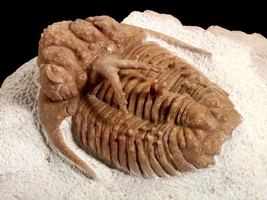
Most fossils are dated using relative dating techniques, which determine age by comparison rather than by assigning an exact number of years. With relative dating, a fossil’s age is inferred by comparing it to rocks or fossils whose ages are already known. For example, if a trilobite fossil is found within the Wheeler Formation, and that formation has been dated to approximately 507 million years old, then the trilobite must also be about 507 million years old. But how do scientists determine the age of a rock formation if it has not yet been dated?
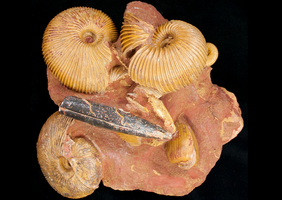
One key tool is the use of index fossils. Index fossils are species that lived during a relatively short, well-defined period of geologic time but were widespread geographically. Fossils such as trilobites, brachiopods, and ammonites are especially useful because they are common, easily recognizable, and well studied. If an unknown fossil is found alongside a known index fossil, its age must fall within the same time range as that index fossil.
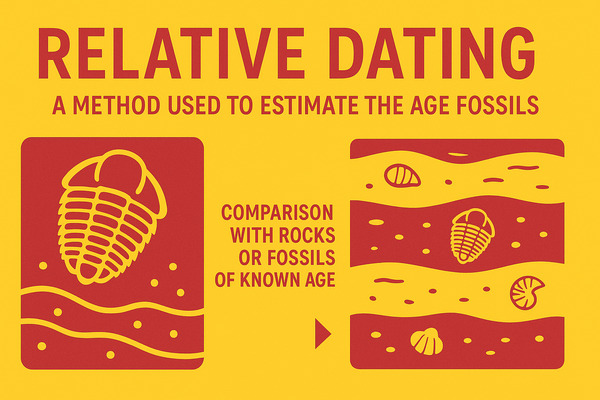
Relative dating of fossils correlated rocks using fossils of known age.
In many cases, multiple index fossils can be used together to narrow the age range even further. For example, a rock layer containing a brachiopod species known to have lived between 410 and 420 million years ago, along with a trilobite species known from 415 to 425 million years ago, must date to the overlapping interval of 415 to 420 million years.
Relative dating also relies on studying rock layers, or strata. Sedimentary layers are deposited sequentially over time, with older layers forming below younger ones. A fossil found in a higher layer is therefore younger than fossils found in lower layers. However, this process can be complicated by geological events such as faulting, folding, and tilting, which can disrupt the original order of rock layers.
Absolute dating is used to determine the actual numerical age of a rock or fossil, most commonly through radiometric dating techniques. These methods rely on naturally occurring radioactive minerals, which act like geological clocks. In practice, it is often easier to date volcanic rocks than the fossils themselves or the sedimentary layers in which fossils are found. As a result, scientists frequently date volcanic ash or lava layers above and below fossil-bearing strata to establish a precise age range for the fossils in between.
Some chemical elements occur in different forms known as isotopes. Certain isotopes are radioactive and break down, or decay, at a constant and predictable rate over time. By measuring the ratio of the original “parent” isotope to the “daughter” isotopes produced through decay, scientists can calculate how much time has passed since the rock or mineral formed.
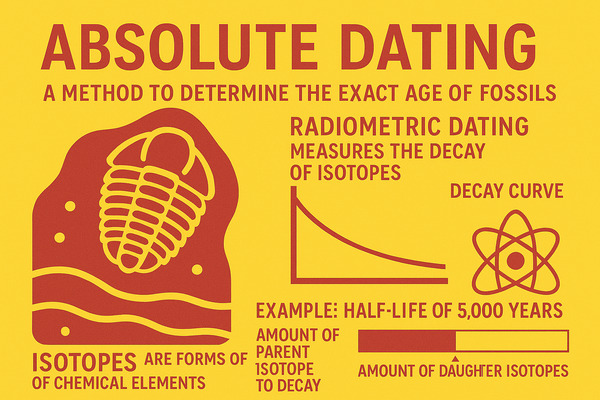
Absolute fossil dating done by measuring radioactive decay.
The rate of radioactive decay is described using a concept called a half-life. A half-life is the amount of time it takes for half of the parent isotope to decay into daughter isotopes. For example, if an isotope has a half-life of 5,000 years, then after 5,000 years only half of the original parent atoms remain. After another 5,000 years, half of that remaining amount will have decayed again.
Although carbon dating is the most widely known radiometric method, it is rarely useful for fossil dating. Carbon-14 has a relatively short half-life of 5,730 years and can only be used to date organic material younger than about 75,000 years. For much older rocks and fossils, isotopes such as potassium-40 are far more useful. Potassium-40 has a half-life of about 1.25 billion years and is common in volcanic rocks, making it ideal for dating ancient geological events and the fossils associated with them.
Relative Dating
Most fossils are dated using relative dating techniques, which determine age by comparison rather than by assigning an exact number of years. With relative dating, a fossil’s age is inferred by comparing it to rocks or fossils whose ages are already known. For example, if a trilobite fossil is found within the Wheeler Formation, and that formation has been dated to approximately 507 million years old, then the trilobite must also be about 507 million years old. But how do scientists determine the age of a rock formation if it has not yet been dated?
One key tool is the use of index fossils. Index fossils are species that lived during a relatively short, well-defined period of geologic time but were widespread geographically. Fossils such as trilobites, brachiopods, and ammonites are especially useful because they are common, easily recognizable, and well studied. If an unknown fossil is found alongside a known index fossil, its age must fall within the same time range as that index fossil.

Relative dating of fossils correlated rocks using fossils of known age.
In many cases, multiple index fossils can be used together to narrow the age range even further. For example, a rock layer containing a brachiopod species known to have lived between 410 and 420 million years ago, along with a trilobite species known from 415 to 425 million years ago, must date to the overlapping interval of 415 to 420 million years.
Relative dating also relies on studying rock layers, or strata. Sedimentary layers are deposited sequentially over time, with older layers forming below younger ones. A fossil found in a higher layer is therefore younger than fossils found in lower layers. However, this process can be complicated by geological events such as faulting, folding, and tilting, which can disrupt the original order of rock layers.
Absolute Dating
Absolute dating is used to determine the actual numerical age of a rock or fossil, most commonly through radiometric dating techniques. These methods rely on naturally occurring radioactive minerals, which act like geological clocks. In practice, it is often easier to date volcanic rocks than the fossils themselves or the sedimentary layers in which fossils are found. As a result, scientists frequently date volcanic ash or lava layers above and below fossil-bearing strata to establish a precise age range for the fossils in between.
Some chemical elements occur in different forms known as isotopes. Certain isotopes are radioactive and break down, or decay, at a constant and predictable rate over time. By measuring the ratio of the original “parent” isotope to the “daughter” isotopes produced through decay, scientists can calculate how much time has passed since the rock or mineral formed.

Absolute fossil dating done by measuring radioactive decay.
The rate of radioactive decay is described using a concept called a half-life. A half-life is the amount of time it takes for half of the parent isotope to decay into daughter isotopes. For example, if an isotope has a half-life of 5,000 years, then after 5,000 years only half of the original parent atoms remain. After another 5,000 years, half of that remaining amount will have decayed again.
Although carbon dating is the most widely known radiometric method, it is rarely useful for fossil dating. Carbon-14 has a relatively short half-life of 5,730 years and can only be used to date organic material younger than about 75,000 years. For much older rocks and fossils, isotopes such as potassium-40 are far more useful. Potassium-40 has a half-life of about 1.25 billion years and is common in volcanic rocks, making it ideal for dating ancient geological events and the fossils associated with them.